About Jodi Kaplan

My Google Profile+

Nine Barriers That Stop You From Getting More Business Online

toll booth barrier image

1. Requiring a login or a particular blog account to comment

Slowing people down only frustrates them. Make comments and contacts easy.

2. Advance “Payment”

Requiring (an email address or a sign up) before a visitor can watch your demo, check out your reel, or see your designs

3. Broken links

Nobody can interact with your site or buy your products if they can’t find them. Here’s a free tool to check your Web site.

4. Flash intros

These irritate people more than I can say; you’re forced to watch something with no way out. Auto play and sound is even worse. Just say no.

5. Asking for Twitter followers upfront

Establish trust first.  Let people get to know you (and your great content) before you ask them to follow you.

6. Contact forms with lots of fields

The more information you ask for (name, address, phone, state, city, country, zip, blood type…OK, I’m kidding about that last one), the less likely people are to fill out your form.  Keep it to a minimum.

7. Leaping before you look

Habitat UK jumped into Twitter and began their tweets with popular hashtags (alert symbols meant to help people follow conversations on a particular topic on Twitter) that had nothing to do with furniture.

8. Talking camera, design, or web geek instead of English.

Your customers don’t care about your cool tools. They care about what those cool tools can do (holes, not drills).

9. Too much information

I was recently asked to review a site that had 45 links on the left-hand menu and another 37 on the right. My head was spinning. Keep it simple. If you’ve got lots of links, put them under pop-out sub-menus.
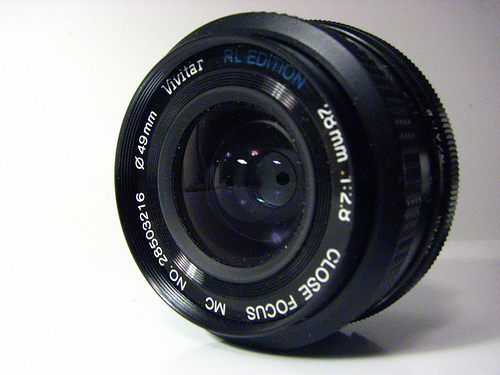

Photo: jetzenpolis

How Do You Focus Your Marketing?

camera lens imageYou’re trying to promote your business.  You want to tell everyone about the great service you offer, your years in business, and your products.

You know this is a mistake, but how do you promote yourself without talking about your service or your quality or your price?

It’s about the lawn, not the grass seed

Why do people buy grass seed? To get a beautiful lawn. You won’t get business by touting years of hybridization to develop your special seed.  You will get business if you offer a solution. Ordinary lawns have to be mowed regularly.  It’s time consuming and hard work.  What if you had a seed that only grew two inches high (then stopped).  Now, a lawn that never needs mowing!  You’d clean up.

Sell holes, not drills

People buy drills because they want to make holes.  The drill is just the means to get the hole. People who buy exhibits don’t really want banners, booths, and brochure stands.  What they really want is to get more visitors at trade shows, more leads, and more customers.  Use your secret identity to figure out what you’re really selling.

Cure your customers’ headaches

What do people hate about exhibits? They’re expensive, it costs a lot to ship them, and it’s hard to dispose of them when they wear out.  Explain why yours are different.  They’re 22% lighter (and cost less to ship), they’re recyclable, or your customers get 36% more leads (include the testimonials to prove it).

Talk about the results (the lawn that never needs mowing) instead of the grass seed (the product).

Not sure where your marketing is focused?  Take the one-minute marketing test and find out.

Photo:  squeaky marmot

How to Stop Cutting Prices and Start Making More Money

wad of cash

Cutting prices is a common strategy to get more sales. Department stores are doing it. Auto makers are doing it. But, it’s a race to the bottom. You cut prices. Your competitor cuts prices. You slash them again; so does she. Meanwhile, a third company outsources their production and undercuts both of you.

There will always be someone in some underdeveloped country somewhere willing to develop web sites, take photos, or create brochures for a tiny fraction of what you need to charge in order to eat.

If you’re in a developed country, you can’t win against someone who can work for $5 a day. And, you shouldn’t try.

Even if you’re competing against the guy down the street, you still can’t compete on price — it’s a death spiral into bankruptcy.

Offer Value

Make your product so compelling, so overwhelmingly worth every penny, that the price is secondary. Add more value (bonuses, checklists, tutorials, how-tos).

Be Remarkable

If you’re worth talking about (wow, he’s the guy with the biodegradable exhibits!), people will tell their friends, who will tell their friends, and so on.

Think Different

Whatever you think of Apple, they’re thriving, even in a down economy, with high prices. They offer an experience, ease of use, and even a sense of belonging to a tribe, that other makers of electronic gadgets don’t. I’ve never heard of an HP tribe, have you?

Convince people that your product is WORTH it, and they won’t care what it costs. They’ll want it.

armagill

Freebie Friday: How to Build Authority, Gain Trust, and Get More Sales

Today’s Freebie Friday is a free report from Brian Clark of Copyblogger, called Authority Rules. Nobody likes a hard sell (including Google). However, if you want to build trust of both search engines and people, you’ll need to establish yourself as a positive, helpful authority in your niche.

But how?

  • gain Google’s trust and rise in search rankings without black hat tactics, keyword stuffing, or “gaming” the system
  • sell without “selling” (you teach instead)
  • develop cornerstone content
  • write for search engines
  • befriend influential people in your niche

Get the full Authority Rules report here.

What’s Your Free Soup Strategy?

free soup image

I got stole this idea from John Jantsch. He and his wife went out to eat, and had a lovely meal. When the waitress brought their check, she also gave them a pint of soup in a takeout container.

Now, he not only wants to return for another great meal, he’s also written about it on his blog and invited readers to submit their own “free soup” strategy.

It’s a great way to exceed expectations, and be remarkable, without a big budget.

Here are some of the strategies his readers used, plus a few of my own ideas:

  • a web developer said he included a free personalized favicon in every site
  • another reader gives away a copy of The Four Hour Workweek
  • a photographer might include a free CD along with photo prints (or vice versa)
  • include a thumb drive with the DVD of your video
  • create a revolving 3-D digital version of your client’s exhibit

What’s your free soup strategy?

Photo: http://www.flickr.com/photos/galant/3201533398/ analvette64

Speaking of free, tomorrow is Freebie Friday.