About Jodi Kaplan

My Google Profile+

The Kosher Tribe Isn’t Jewish

kissesThe New York Times reported last year (10/9/08) that more than 70% of the people who buy kosher food in the US aren’t observant Jews. In fact, the population of observant Jews in the US isn’t large enough to support the market for kosher products.

What’s happening? Many non-Jews are buying kosher products because they believe they are higher quality, or rely on strict ingredient labeling to protect them from food allergies or other religious concerns. According to The Times, many candy and cookie companies regularly ask for kosher certification for Christmas and Easter confections!

I, personally, once helped a Muslim immigrant from Afghanistan choose a brand of jam based on the fact that it was kosher pareve (no meat or dairy products), proof that it contained no pork or other ingredients he couldn’t eat.

The lesson from this is that it’s important to know who your customers really are (and to adjust your products and services to meet their needs). Otherwise, how would a candy company ever know (or think) to make kosher Easter bunnies?

Photo: rushingmania

Are You Scaring Your Customers?

Friday the 13th is traditionally a good time to watch scary movies, but that doesn’t mean the fright should extend to your business.

If your phone systems are complicated, it’s hard to reach the right department, and hold times are really long, you may be scaring your customers away.

Multichannel Merchant reports (Feb. 10, 2009) that a recent survey of e-tailers found that service levels have slipped considerably in the past year. The report found that the number of e-tailers offering 24/7 service access has dropped to 27% (from 39% the year before), and the shipping times had increased to nearly 5 days.

However, the biggest problem was customer service rep knowledge. There’s more outsourcing (to save money), training levels have dropped, and the reps don’t know as much about the products as they should. Customers are frustrated, because they can’t find what they want, get product questions answered correctly, or solve problems.

The article quotes E-tailing Group President Lauren Freedman saying, “‘There’s not enough emphasis on building a customer service culture anymore.” What happens is that “bad” culture leads to poor email service, a poor call center, and finally, …”you open up live chat and you’re bad at that too!”

There were some bright spots though. The service winners included Brookstone, Lands’ End, Brooks Brothers, and Bluefly.

Meanwhile, I had an excellent “customer service” experience when I called the city of New York City information line the other day. Instead of trying to figure out which of the gazillion possible city offices to call when you have a problem, you just dial 311.

Here’s what happened. I was looking out the window and saw lots of water pouring out of my neighbor’s town house, into the yard. Something was clearly broken, but I had no idea what or who to call about it (neighbors weren’t home). So, I called 311.

After one or two push button choices, I got a real person. I explained the problem and she transferred me to the Department of Environmental Protection. I repeated it, and after speaking with a supervisor, the rep decided the problem required the fire department. She connected me, and gave ID info to the operator. I explained the situation, and the 911 operator notified the fire department.

The whole thing took maybe 5-10 minutes. A fireman was at my door (to look down at the problem) about 3 minutes later.

They turned off the water (it was deep enough to slosh around in) and the immediate problem was solved (though I understand the owners found a big mess when they came home).

If a big bureaucracy can do it… you can too!

Photo:wordridden

The Truth About SalesGenie

SalesGenie is big, they’re splashy, they advertise on the Super Bowl regularly (not necessarily the best use of money for a company in danger of losing their listing on the stock exchange). But are they a good source of leads?

I’ve seen lots of people on forum after forum, suggest using SalesGenie or InfoUSA lists. One word: DON’T.

I’ve also seen customers report error rates as high as 27%! (the error rate, or returned mail, should be closer to 2 or 3%).

Their lists may look cheap, but they’re not a good value.

Remember, the list is the most important part of your mailing. It accounts for 40% of the response you get (the rest is the design, the copy, and the product offer).

SalesGenie data is compiled. That means it’s pulled from directories, web site listings, and other relatively static sources that don’t update very often. It also means that none of the people on those lists have raised their hands, saying, “Help me, I have a problem” or “I’m interested in your product.” It’s a cold contact; the least likely to do something. It’s a list of names, not a list of prospects.

This will increase your costs (more printing, more postage, more phone calls, more emails) and decrease your response.

Whether you’re mailing, or emailing, or telephoning, or placing an ad, the people you want to reach are people who have specifically requested information and messages from you or someone like you. You want prospects who have already bought something (or expressed interest in something) similar to your product, and have purchased it from a place that sells similar things in a similar fashion.

Photo:
Charles and Clint

How to Get More Sales From Your Web Site

Photo: bull3t

What people see when they first visit your site can make a big difference in the number of sales you get. When someone comes to your site, your goal is to get them to do something (download an article, sign up for a newsletter, or just find out more about you.

Here are some tips on how to improve your site, and make it easier for your prospects to do what you want.

Skip the introductory flash/enter page. Send people straight to the information they’re looking for.

Avoid script fonts. They’re hard to read on a computer screen, and tend to blur slightly (even on a large screen).

Center your images. I just looked at a site with photo on top that wasn’t centered properly. There was a line down the middle of the image and part of it repeated towards the right side of the page.

Be clear and simple. Make sure your pages load quickly. Don’t use lots of large graphics. Use a thumbnail image and add a click-through to a larger one if necessary (so buyers can get a better look at something). Clearly mark your links (underlined or a different color).

Contrast is important (especially online). Don’t use too much of a single color.

People buy from people. If you’re selling a membership, or access to an expert, put his or her photo on the site.

Paint mental pictures. If you sell a product, add descriptions that bring them to life. The reader should be able to imagine the result as well as see it: “Each design is individually hand-crafted in a process that takes 15 days to complete. Using tools no larger than a pin, the artist carefully joins together 20 pieces to create his sculpture.”

Be specific. Don’t say, you’ll save hundreds of dollars, or free extra reports worth thousands. Use an exact number instead; such as “save $155” or “free reports valued at $1,245.”

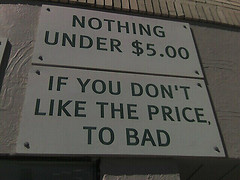
Ten Common English Grammar Mistakes That Make You Look Dumb

It’s easy with the speed of blogs, spell check, and online tools to dash out a quick post, a comment, or even a brochure that’s full of mistakes. Typos do happen, but sometimes a mistake can just make you look foolish (and hurt your credibility).

Here are ten of the most common English grammar mistakes and how to stop them before they stop you.

1. You’re/Your

Your refers to something that belongs to you. Use it to indicate possession of something, such as “your toothpaste” or “your shoes.”

You’re is a contraction of “you are”, a noun (you) and a verb (are).  It is usually followed by an adjective describing something about you or something you are doing, such as, “You’re tired,” or “You’re tall.”

2.  It’s/Its

It’s is a contraction of “it is,” use it to indicate an action or a description of something.  “It’s raining.”

Its indicates possession.  “The dog is chasing its tail.”  The tail belongs to the dog.

3.  Lose/Loose

Lose: indicates that something is missing.

Loose:  describes something that’s not restrained  (an animal that has gotten away, hair that has been taken out of a ponytail).

4.  Compliment/Complement

A compliment is a kind word or expression of admiration for something.  “Nice shoes”!

When one thing goes well with something else, they complement each other.  “That blue shirt complements your blue eyes.”

5. Affect/Effect

Generally, “affect” is a verb, while “effect” is a noun.

Affect changes what happens.  “The rising price of oil affects the price of food.”  Higher oil prices mean increased costs for fertilizer, storage, and transportation, so the price of food rises.

Effect is the result.  “The rising price of oil had an immediate effect on the price of food.”  The result of higher prices for oil is higher food costs.

It is also used to show the way one thing influences another.  “The effect of the new law banning smoking in public places has been to reduce the costs of health care.”

6.  Random Apostrophes

Use an apostrophe to indicate possession.  Examples are “Bob’s shoes” or “the cat’s toys.”

Don’t use them to make something plural!

7.  There/Their/They’re

“There” is a location.

“Their” is used for something that belongs to others (their house, their books).

“They’re” is a contraction of “they are.”

8. To/Too

“To” is a preposition.  “We’re going to the store.”

“Too” means also or in addition. ” I like chocolate too!”

“Two” is a number.  “My friend Bonnie has two kittens.”

9.  That/Which

This one messes me up sometimes, but I try to remember “that” is specific, and “which” is not.

That copy machine is broken.

Which machine isn’t working?

10.  Whose/Who’s

“Whose” is possessive.  “Whose bike is that”?

“Who’s” is a contraction.  “Who’s the guy riding that bike”?

Photo: ifindkarma