A Lesson in Penny-Pinching from the Pentagon

penniesNewsweek reported (April 19, 2009) that the Pentagon is using a new “weapon” in Iraq. A redesigned Humvee? An improved rifle? Nope. An iTouch.

What Can the iTouch Do for the Pentagon?

It’s certainly not the first gadget that comes to mind when you think of the army, but they’re using it to translate, store video (say of a tribal leader advising villagers to cooperate with the soldiers), and share data about suspected insurgents. Since it has an existing support structure and development tools, it’s not difficult to find programmers to produce specialized applications to display video from drones or use the iTouch as a remote control for a bomb-disposal robot.

Say Goodbye to $400 Hammers

Instead of following the well-worn path to $400 hammers and $5,000 toilets, someone decided to look past the military-industrial complex and use comparatively cheap, off-the-shelf tools.

You don’t need boatloads of money to be successful; you do need to think creatively. Leverage what you have. Use existing resources in different ways. The founders of Apple, Yahoo!, Blogger, etc. didn’t have VC funding. They had ideas, and the ability to execute them (dreaming is great, but without execution it goes nowhere).

Draw Outside the Lines

In a recession, it’s even more important to look at where you’re spending money and figuring out how to get better results from your efforts. Are you better off Twittering? Or putting an ad in a (gasp) magazine? Should you concentrate on brand awareness? Or monitor the Internet for mentions of your company name and brand (positive or negative)?

It’s not about the money. I once ran a very successful marketing campaign for $75; more on this Monday.

http://www.flickr.com/photos/totalaldo/503335275/ total aldo

Get more business now. Click here for your free ebook.

A Customer Service Lesson from the Building Super

I’m sitting home waiting for the super.  If you look at the picture on the right you’ll see why.

Unlike the last super, this one is readily accessible.  He answers the phone at all hours (even last night at 8 when this started as several small leaks).  He arrives on time, and he fixes whatever is broken.

The last super never answered the phone. I always got a machine, and it took hours to get a reply.  Sometimes it took days.  I’m not directly paying the bill, but when there’s a leak, or the toilet won’t stop running, it’s good to know that someone cares about customer service.

Take a few minutes to think about  your company’s service.  Call in from home or your cell.  Pretend to be a customer.  See how you’re treated.  Do you have to wait on hold for a long time?  Are your questions answered?  Are the answers helpful?  What happens when you email a question or a problem?  Does someone answer promptly?  Do you get a canned response or a personal one?

Your customers will feel better (even in a disaster) if you show up, answer the phone, and try to help.  If you solve their problems quickly and effectively, they’ll love you.

Get more business now. Click here for your free ebook.

Why are Referrals Like Buried Treasure?

treasure map

Getting referrals can be like finding buried treasure. They’re a low cost way to get more business, and come with a built-in testimonial from someone who already knows you. But how do you get more of them? And, do you know what triggers someone to refer you?

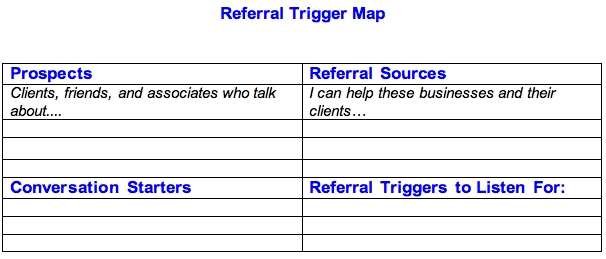
If not, you’ll need to create a “Referral Trigger Map”. Here’s how to do it.

Set up a document (or a spreadsheet) with a table. Create two columns, one labeled “Prospects” and the other Labeled “Referral Sources”. Under Prospects, type “clients, friends, associates who talk about”…. Under Referral Sources, type “I can help these businesses and their clients…”

Under the Prospects column, list situations and discussions that would lead a friend, current client, or associate to refer you.

Then match up the situations with businesses and people you frequently come in contact with. Do they have a problem you can solve? Or, do they know other companies that do? Add those to the Sources column.

For example, if you’re a Web designer, a trigger point might be a small business owner frustrated with a designer whose business to business Web designs turned out to be pre-fabricated templates with daisies and teddy bears (you may laugh, but this has happened).

Then, make a second table with the headings: “Conversation Starters” and “Referral Triggers to Listen For”.

For the Web designer, it might be expressing sympathy with the business owner, and offering her the opportunity to discuss a more professional solution.

If you build super-light exhibits for trade shows; a trigger point might be hearing someone complain about the $1,000 they just spent to have their exhibit shipped.

It should look like this:

Download the map and take a few minutes to fill it in. See what treasure you can find!

Get more business now. Click here for your free ebook.

Can Your Marketing Pass This Test?

Go to your Web site. Print out your home page. Now, take a pen and cross out every mention of your company’s name, products, or services. After you’re finished, substitute the name of one of your competitors instead.

Now, reread the whole page. Does it still make sense?

If it does, your marketing isn’t as effective as it could be. Generic marketing isn’t effective (it’s broken). It won’t lead anyone to choose your product or service over your competitors’.

Saying that you offer “high quality” or “fast response” or “creative design” isn’t enough. You have to differentiate yourself in some way.

How?

Blockbuster is failing, but there are video stores specializing in horror movies or Japanese anime that are thriving. Netflix succeeds by not only stocking movies that Blockbuster never heard of, but by emphasizing local favorites. They also create lists of movies they think you’ll like based on past picks and preferences (for me, they’re currently recommending cerebral TV shows, dark political movies based on real life, and suspenseful crime dramas).

A dry cleaner is a dry cleaner, but a green dry cleaner or one that picks up early in the morning and delivers late at night is different.

A trade show exhibit designer is generic, but one that produces exhibits that can be set up and broken down in 10 minutes is worth remembering (and talking about).

Go, test your site now. Let me know what you found.

Photo: ccarlstead

Get more business now. Click here for your free ebook.