About Jodi Kaplan

My Google Profile+

It’s a Toy! It’s a Business Tool! It’s Wordle!

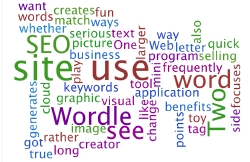
The creator of Wordle says it’s a toy. It’s true that is fun to play with, but it’s also got a serious side. It’s a mini application that creates a graphic image of the word on your Web site or other text. The more frequently you use a word, the larger it will be in the picture that Wordle generates (like a tag cloud).

Two ways to use this:

One: As a SEO tool. It’s a quick, visual way to see whether the words on your site match the keywords you want to use for your SEO program. If not, change them!

Two: See if your site (or letter) focuses on on selling points and benefits, rather than how long you’ve been in business.

Try it at http://www.wordle.net/create

Six Things You Should Know Before You Rent a Mailing List

ONE
How often it’s updated (the older the list, the more out-of-date it is. You want to pay for current names (not outdated ones)

TWO
How they get the data (is it compiled, from a paid directory, from a subscriber list)

THREE
What other kinds of companies have used the list (if you’re in the electronics industry, a list used by toothpaste manufacturers may not be right for you)

FOUR
The products those companies were selling (look for products and services similar to yours. If you sell seminars on HR training, look for lists used by other companies who sell HR training)

FIVE

Whether they rented it again (a sign of how well it worked)

SIX

How often the list is rented (a way to tell if the list is being used too much)

Should Your Copy be Long or Short?

“Some say, ‘Be very brief. People will read but little.’ Would you say that to a salesman? With a prospect standing before him, would you confine him to any certain number of words? That would be an unthinkable handicap.”

Those words were not written in the age of the Internet. They were penned by Claude Hopkins, over 100 years ago, in his book Scientific Advertising (get a free copy here).

What held true then still holds true today. Use the number of words, amount of benefits and features, and the information you need in order to make your sale. No more. No less.

Tell your whole story. Consider that your reader is someone who knows little or nothing about your product. The people already using your product are unlikely to read your ads. Instead appeal to prospects; people who either don’t know you, or know little about you.

Tailor your appeal to those people and those people only. The readers you want are the people who are interested in your offer. Nobody reads ads for fun, regardless of their length. Think of your readers as prospects, standing in front of you, looking for information. Give them what they need to take action.

Seek to persuade, and gain sales (not applause or awards). Have a picture of your ideal customer in mind; her likes, dislikes, habits, and problems. Then create your advertisement based on what you would do face to face. Don’t write your ads to please yourself. Write them to please your customer.

Will Your New Product Succeed or Fail?

You’ve got a great idea, and a brilliant marketing campaign, looks like all is good to go. Right?

Or wrong?

Jim Kronenberger (current Director of Sales at American Le Mans Series) said on LinkedIn that he once worked for a company that had a great marketing idea. They rented two bright yellow Hummers, loaded them down with emergency communications gear, and made the rounds of state and local agencies.

The agencies loved it! They had few plans for a disaster and really wanted a solution.

So far, so good. The company found a problem, created a solution, and selected a market that desperately wanted their product.

But something went wrong. It seems that the agencies had no money to pay for the equipment. They needed a 1-2 year lead time to apply for grants and get the funds necessary to purchase the equipment.

The agencies had a need, but no authority and no money. Eventually, – after wasting lots of time and money – Jim’s employer had to give up.

When looking for prospects, or generating ideas for a new product, ask yourself:

1) Is there a need for this?

2) Is there a niche I can exploit?

3) Is the market for this product big enough? You may love garlic and sausage-flavored ice cream, but will anyone else?

4) Can your target market afford your solution? There’s no sense trying to sell Louis Vuitton handbags to people applying for food stamps.

5) M-A-D (not angry – but Money, Authority, and Need). Make sure the people you’re talking to have all three.

When promoting your product, don’t assume that your customers’ tastes, opinions, and habits mirror yours exactly. Choose based on what will truly appeal to them (not what appeals to you).

If you’re not sure, ask them!

What’s the most critical part of any direct marketing campaign?

Without this one thing, the whole campaign falls apart. Unfortunately, it’s also often the most overlooked part of a marketing effort. It’s not the graphics, or the words, or the size of the brochure that matters the most. It’s not even what you’re offering or the price.

The key to success (in fact up to 40% of your return) is… the list.

Teenagers won’t buy your denture cream (no matter how slickly produced your ad is).

Since the list is so important, treat it carefully. Don’t look for the cheapest list, look for the list of people that best matches your target audience. It’s tempting to get compiled lists (like those from InfoUSA) because they’re inexpensive. But there’s a hidden cost – bad data. Purchasers have reported up to 27% error rate (a clean list has an error rate of 2-3%).

Good B to B lists can cost up to $275 per thousand names, so choose wisely. Look for lists of purchasers, attendees, or subscribers. Ask for a data card. This is the list’s biography. It shows when the list was last updated, the pricing, the demographics of the people on the list (age, income for consumers or titles, industries for businesses), and the different selections available. A selection is a subset of the list, for instance, only people in manufacturing businesses or only people with incomes over $50,000.

Where do you find lists?

Call a list broker. (contact me and I’ll give you the name of a good one). List brokers have access to thousands of data cards on thousands of lists. Tell him (or her) your target audience, your product, and your offer (what you’re selling and for how much). Also, send a sample of your brochure or a link to the Web page for the product.

Check direct marketing publications. Direct magazine or DM News. Both are free, and keep their subscribers up to date on new lists.

Contact trade publications in your industry. Many will rent the names of their subscribers.

Build your own. Create a newsletter, e-book, or free offer, and build a list of people who want to hear from you.